
Free Consultation
Call Us
(720) 379-6363
Text Us
(719) 534-3132






 Recent Posts
Categories
Archive
Recent Posts
Categories
Archive
Written by Remington Fang
Unexpected crashes involving off-highway vehicles leave riders facing injuries, medical treatment, and lost income while legal questions mount. Colorado ATV laws govern how responsibility, reporting obligations, and safety standards apply after these incidents. Those regulations influence insurance evaluations, fault determinations, and available compensation from the earliest stages of a claim.
Riders across Denver encounter heightened risk due to crowded trail systems and shared access points where off-road vehicles intersect with traffic. At Fang Injury & Accident Lawyers Denver, we help injured riders navigate these legal challenges and pursue financial recovery when unsafe conditions or negligent conduct cause harm.
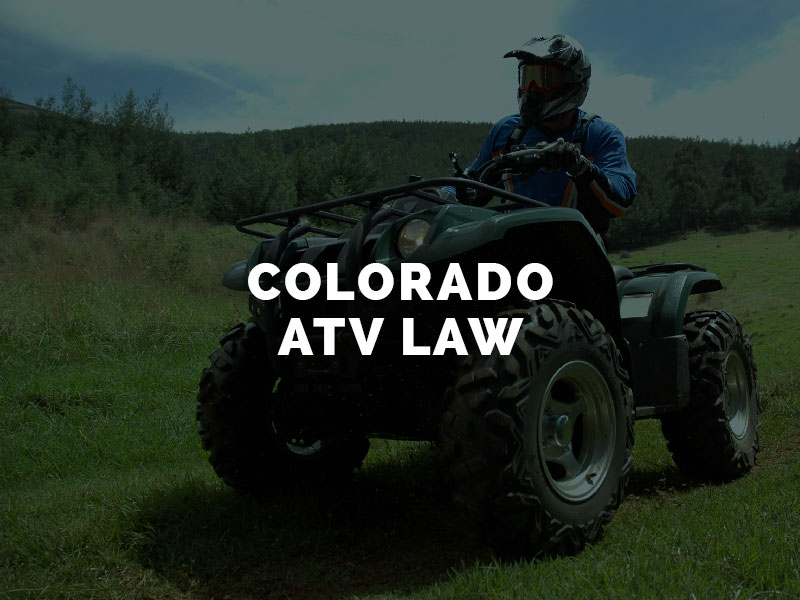
No, ATVs are not street-legal vehicles in Colorado. According to Colorado Revised Statute 33-14.5-108, you cannot operate an ATV on any public roadway, highway or street in Colorado except in emergency situations or for agricultural purposes. The only exception is if the tract of public land or road has signs designating them for ATV or utility vehicle use. It is dangerous to operate an ATV on the street, as manufacturers do not design them for use on pavement. An ATV operated on pavement is more prone to rollover accidents.
No, Colorado law generally prohibits ATV use on highways and public streets. State statutes restrict off-highway vehicles from paved roads due to rollover risk and the lack of required street safety equipment. Limited exceptions apply for agricultural purposes, emergency travel, or roads clearly marked for off-highway access.
Riding outside approved areas often results in citations and can complicate injury claims if a crash occurs. Police reports frequently document unlawful roadway use, a factor insurers rely on when assessing fault, particularly in Denver where traffic density increases the likelihood of serious injuries.
You can ride ATVs in Colorado on designated roads and trails, as well as on private properties. Colorado allows ATVs in designated areas within the Grand Mesa Uncompahgre and Gunnison National Forests, for example. You can take an ATV or other off-highway vehicles on dozens of trail riding areas and certain roads in the national forest. The government may close some roads to ATVs for safety reasons or due to traffic volume, however. You may also face seasonal or temporary road closures based on environmental conditions. Colorado upholds a “leave no trace” etiquette for all ATV riders. To find out where you can ride an ATV in your county, check with your local sheriff’s station for specific user information.
You do not need auto or another type of insurance to operate an ATV in Colorado. Purchasing additional ATV liability protection through your homeowners’ insurance policy, however, could be a good idea in case of a motor vehicle accident. Homeowners insurance that covers ATVs could reimburse you for repairing or replacing a crashed, damaged or stolen vehicle depending on the situation and policy. This could save you a considerable amount of money depending on your ATV and the extent of the damage.
Yes, all ATV owners in Colorado must register and number their vehicles, according to C.R.S. 33-14.5-112. Operating an unregistered ATV, or even owning one, is a crime. Colorado requires registration of all ATVs and utility vehicles in the state, with a few exceptions. You need proof of ownership to register your ATV in Colorado, such as a bill of sale, receipt or certificate of title. You will not need to register your ATV if you are a resident in another state and will be in Colorado for less than 30 days, will only use it for agricultural purposes or an organized race, or will only use it on private property.
You must be at least 10 years old to operate an ATV on public roads in Colorado. This age limit does not apply to private properties, however. ATV operators on public roads between the ages of 10 and 16 must have with them a supervisor with a valid driver’s license. The supervisor must keep the ATV rider within sight at all times. If a child does operate an ATV on public or private lands, the vehicle should be designed specifically for children. A child could suffer serious personal injuries trying to operate an ATV designed for adults. Always follow the operator’s manual for safe and proper use.
Colorado regulates off-highway vehicle use through rules addressing rider age, supervision, and manufacturer-installed safety equipment. Operators between ages 10 and 16 may ride on approved public routes only under supervision from a licensed adult. When seatbelts or child restraints come installed by the manufacturer, riders must use them in compliance with motor vehicle standards.
Safety compliance affects more than citations. According to the Colorado Department of Transportation, protective measures reduce injury severity during crashes. Violations of these rules often influence fault and compensation after an off-highway vehicle collision.
You will only need to wear a helmet on an ATV in Colorado if you are under the age of 18. Riders 17 and under must wear safety helmets that pass the Department of Transportation’s safety standards. Other equipment all ATV riders must have to ride on public roads in Colorado are a headlamp, tail lamp, muffler, spark arrester and brakes. Riding without this equipment or a good helmet, if applicable, could lead to a citation.
Colorado Revised Statutes § 33-14.5-109 requires riders to promptly report qualifying off-highway vehicle crashes to law enforcement. Reporting becomes mandatory when a crash causes significant property damage, requires hospitalization, or results in death. Proper notification creates an official record of the incident, which often plays a key role in insurance reviews and injury claims.
To properly report an ATV accident, take the following steps as soon as possible:
Failure to report a qualifying crash may lead to penalties and complicate recovery options under Colorado ATV laws.
Serious off-road injuries can disrupt your health, income, and long-term stability, especially when a crash involves violations of Colorado ATV laws that complicate liability and insurance decisions. At Fang Injury & Accident Lawyers Denver, we help injured riders navigate these challenges and pursue compensation after an ATV-related injury. Call 720-379-6363 to schedule a free consultation and discuss your options.
A Colorado Springs native with a lifelong passion for standing up to bullies, Remington fights for the injured against corporations that put profit over people. Raised in a family devoted to service and healing, he brings compassion and grit to every case.
A graduate of the University of Northern Colorado and the University of Arkansas School of Law, Remington has recovered millions for clients with Fang Injury & Accident Lawyers Denver. He believes no injury should silence the human spirit — and he won’t stop fighting until justice is served. See Remington in AVVO.

This page has been written, edited, and reviewed by a team of legal writers following our comprehensive editorial guidelines. It was approved by Remington W. Fang, our Founding Partner, who brings over 10 years of experience as a personal injury attorney.
 call us at (303) 710-8621